


California Vehicle Code 21960, as changed by SB 1233 (of 2004),
eliminated the right of bicyclists and pedestrians to use public
roadways
Akos Szoboszlay
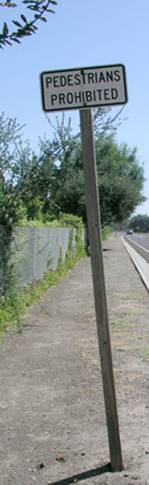
Photo: The pedestrian path is prohibited by the posted sign stating “pedestrians prohibited”. County highway staff refused to remove these signs despite Sunnyvale informing them to "remove all signs that prohibit pedestrian use". They secretly started SB 1233, a bill that eliminated the right of non-motorists to use public roadways, without ever informing the BPAC or the public, so they would never be required to remove them.
Forward: The County Board of Supervisors voted to seek legislation in 2004 to eliminate non-motorists rights (described below),
but in 2006, realizing their mistake, voted to seek legislation to un-do what was passed in 2004. However, staff never complied.
This article was written in 2005, and subsequent events are listed on the Contents, Links page.
Santa Clara County sponsored portions of Senate Bill 1233 [SB 1233], the
“Transportation Omnibus bill” (sections 15, 17, and 28), in April of 2004,
which eliminated the right of bicyclists and pedestrians to use all public
roadways, Statewide, without disclosing the effect that the change in law would
cause. The County’s letters to the Senate and the Assembly Transportation
Committees (by Supervisor McHugh, Chair), directly contradicted the County
staff report of
The County also recognized, in its staff report of
SB 1233, according to the legislative analysis, “is intended
to deal with minor, non-controversial issues” and “would make ...
non-substantive changes.” On the contrary, it was very controversial because
there was an ongoing dispute between the City of
The County never authorized seeking such legislation, but
something very different. It was improperly agendized, to hide it, and it
lacked a public process, as detailed in Appendix D.
The summary of SB 1233 misleadingly states: “Authorizes a
county to post signs prohibiting pedestrians.” The bill did not authorize posting,
which is already authorized by CVC 21351,
which states: "Local authorities ... may place ... traffic signs ... as
may be authorized." Instead, it greatly expanded authority to prohibit
bicycles and pedestrians, by eliminating two stipulations in CVC 21960, the
boldface in this quote: "Local authorities ... may [for] freeways [where] all rights of access have been acquired ...
prohibit ... pedestrians, bicycles ... motor-driven cycles ... ." It
authorized prohibiting,
not posting,
but the
summary had no mention of prohibiting or
of bicycles. The proponents used
deception in the summary to prevent opposition.
[Update: County staff
reveals the real reason for SB 1233.]
These sections of SB 1233 also contradicted CVC 21949 which states: “all levels of
government ... provide convenient
and safe passage for pedestrians on
and across all streets and highways,
increase levels of walking and pedestrian travel, and reduce pedestrian
fatalities and injuries.” It also contradicted the similar ACR 211. The purpose of seeking legislation was to legitimize the
practice by the County of eliminating pedestrian and bicycle facilities when
adding more lanes for automobiles. In all cases, this has occurred not for lack
of right-of-way, but because posting of “pedestrians bicycles ... prohibited” signs
is cheaper than relocating these facilities when traffic lanes are added. Such
action, again, contradicts CVC 21949.
[For latest events: See the Contents, Links page.]
Appendix contents.
Appendix A: The County contradicted its letters to the Senate and Assembly Committees
Appendix B: Three intentions of SB 1233 were contradicted
Appendix C: Goal to conform CVC 21960 to CVC 21949 and ACR 211
Appendix D: Deception and all lack of public process at the County level
Appendix F: Text of changes to CVC 21960.
Appendix G: Text of changes to Streets and Highways Code 1730.
Appendix H: Letter from County to Senate Transportation Committee.